

Off to Sea Once More

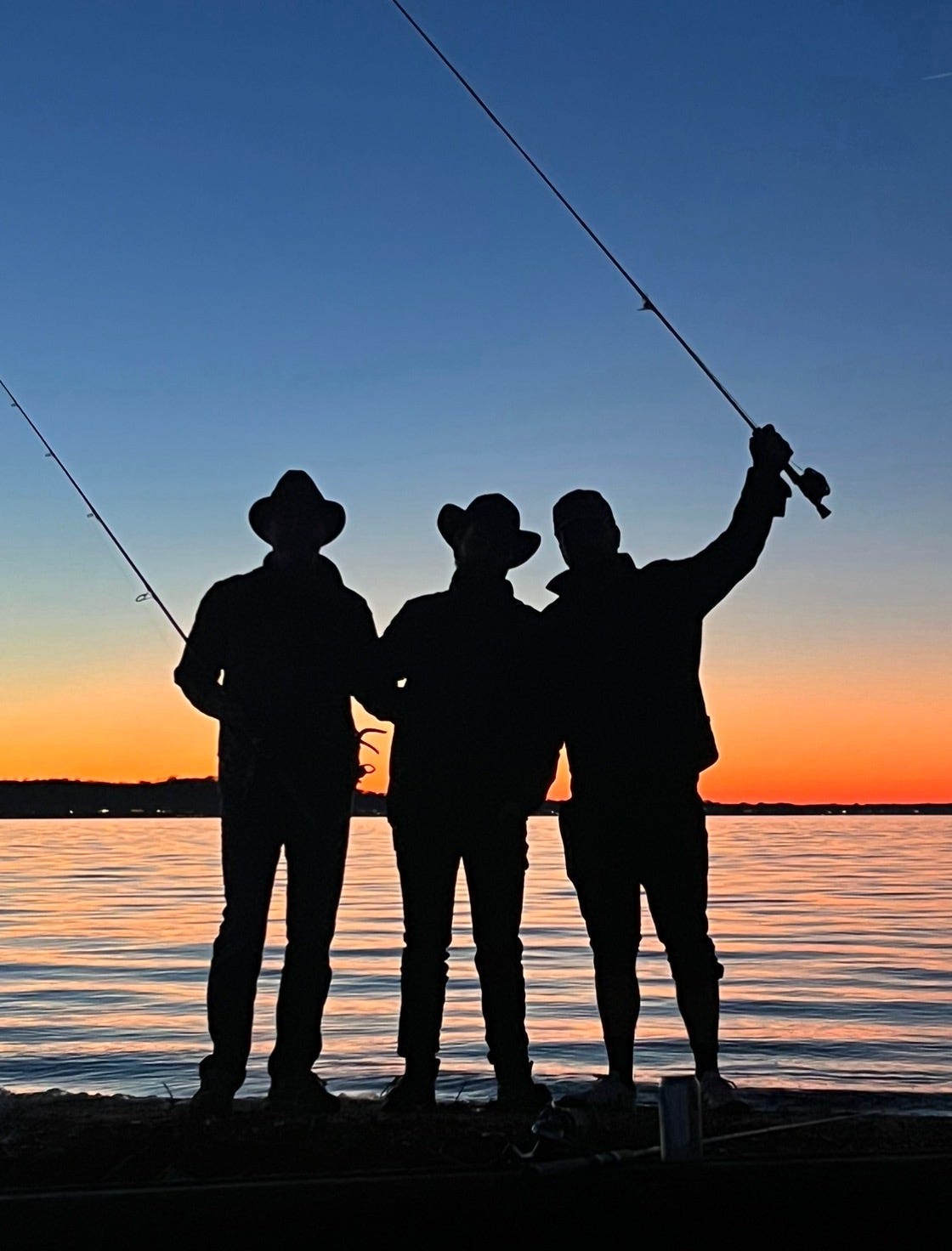
I find that the darkness is my least favorite part of winter in New York City. It has a way of making the already-small spaces you inhabit feel even smaller and less significant.
Early spring is fickle as well, with its extra hours of sunlight regularly blotted by rain clouds and sharply dropping evening temperatures. This year’s wet spring has driven flows up across the Northeast, and swelling rivers have discouraged eager freshwater fishermen, including me. The dreary spring months do hold a silver lining, however, for impatient anglers, one that requires a trip down the Jersey Turnpike to a place where spring gains its footing more quickly—coastal Maryland.
My first outing began about as casually as the act of fishing can. Countering a flooding inbox with black coffee, I took in the gentle scenery from my family house perched atop a bluff on an island on the Chesapeake Bay. It was around 11 a.m., and my brother, Henry, had begun to shake off the cobwebs following his customary decadent breakfast: five eggs, an over-toasted bagel with cream cheese, raspberry jelly, and a cornucopia of assorted fruits. He sat opposite me in a lounge chair, mindlessly scrolling through an iPad and emitting an occasional chuckle.
I seized the moment to plant the seed, penetrating the gentle fizzling hum of a Bach concerto. “We’re fishing around 2 this afternoon. Might be too early for the bass and probably too soft of a tide for the inshore striper. But…”
“Sounds good to me,” he said, taking no time to contemplate. We didn’t care about the probability of fish, only about shaking off the dust coating our lines, both eager after a long absence from the water, with a day at the island together in front of us.
As the day rolled into early afternoon, we loaded our old golf cart, a traditional four-seater with a broken suspension and a battery-powered engine that moaned up every hill. I considered stringing my Echo nine-foot eight-weight and shaking the rust off my double-haul, but time was scarce and the upside low. The saltwater fly outfit would have to stay in the garage for another day and wait its turn.
Instead, we kitted out two St. Croix medium-heavies equipped with Shimano reels brimming with 20-pound braid. Strapping pliers and reliable folding knives to our belts, we began our descent into the woods. As the cart pitched and rattled across the dirt road approaching the island’s freshwater pond, we noted the hanging moisture in the air, the cool easterly breeze, and our low expectations.
We parked on a grass patch adjacent to the pond, which stretches about a half mile northwest from the road, curving against an overhanging deciduous forest. We began casting from the causeway into the flats abutting the road, the causeway running between the pond and the Chesapeake Bay at our backs. During storm surges and particularly high tides, the bay entirely consumes the causeway, reclaiming the pond as if reuniting with an old friend.
Following a series of casts across the flats, we agreed that, as predicted, it was too early for the bass. They hadn’t moved to their beds to spawn yet, which typically coincides with the blooming of the rosebud cherry and dogwood trees lining the banks above their habitat.
“Let’s take a few casts on the bay side, see if there’s any activity around the pipe,” I proposed, breaking the meditative whirring and splashing of our syncopated casts, the decision being more an act of restlessness than a strategic one.
My brother agreed, and we crossed the small wooden bridge over the marsh that spans the Chesapeake Bay. The Pipe is one of our preferred spots on the island to target striped bass in-season. Large and rusted, it forms a conduit between the bay and the pond and carries nutrients, baitfish, and other creatures back and forth depending on the tides and the direction of the wind. This creates a natural allure for predators traveling by air, land, and sea (and, in some cases, golf cart).
The usual suspects at the pipe include varieties of heron and egret, osprey and eagles, and striped bass from the depths of nearby shipping channels. It is often immediately apparent if there’s anything going on at the pipe, as it is one of the primary staging areas for the island’s natural buffet. Today, it appeared the table was being set.
As we approached the shore, marked by long stone jetties, we could see pockets of turbulence in the water. These indicated the presence of baitfish clusters, and their movements, irregular and panicked, signaled they were being pursued from below. Osprey hung suspended against the easterly breeze above us, stationary like kites on strings, diving on occasion. They weren’t coming up empty-handed.
“Looks pretty fishy, doesn’t it?” Henry noted, shooting me a look with a cocked eyebrow, the excitement in his tone palpable. I concurred, doubling back from the jetty in a jog to retrieve a “Spook” for both of us, the preferred surface lure in any situation where we detect the presence of predatory fish in shallow water.
We began casting, targeting what had become a swelling and boiling 8-by-10-foot cluster of mobile turbulence that we knew to be a bait ball of gizzard shad. As the school zigged and zagged about 50 yards out from our positions on the jetty, our anticipation began to spike, our heart rates along with it. We knew opportunity was imminent and would unveil itself violently.
I cast across our perceived strike zone, the spook skittering nervously about 30 yards from shore, and the first striper presented himself, crashing heavily through the baitfish and displacing about as much water as a yellow Lab jumping off a dock. “Holy shit!” I exclaimed. “They’re here, and they’re big!”
The striper had missed my lure, but the dinner bell had rung, and the game was on.
Henry dialed a cast into the strike zone next, landing his spook with extreme precision in an area the size of a doormat, five feet or so from the ripples where the big fish had disappeared. As his spook sliced through the gray expanse, the fish turned, lunging and bumping the lure about three feet forward, an effort (we postured) to stun the shad. This is usually followed by the predator’s signature tail-thrust and explosive gulp.
In this case, things played out exactly as we’d hoped. Three or four more feet of progress for the small lure enticed a wild explosion. The spook was gone, followed by the immediate doubling-over of Henry’s rod. The whistling gears of the drag on Henry’s reel and the mist kicking off the braided line signaled that the fish had turned in a furious path toward deeper water.
“Let it run!” I exclaimed, as about 150 yards of line continued to peel off Henry’s reel.
He leaned back against the rod, embracing the state of adrenaline-fueled bliss, and prepared himself for battle. The medium-heavy St. Croix outfit would be tested to its full potential in the coming minutes.
Time passed in warp speed, as it does in these situations, and after what could have been twenty minutes or two hours, the fish’s angry runs began to shorten and become less decisive, indicating fatigue on the part of our aquatic adversary. Concurrently, Henry was managing to work line back onto the reel, a positive development that helped cool our nerves and boost our confidence about the connection between the lure and the fish.
Most of the instances where we had lost large fish (which were countless) happened on the fish’s first or second run. Usually, a flaw somewhere in the rig rears its ugly head—nicks in the line, faulty gears in reels, weakened sections of rod. My paranoia was heightened by a life of fly fishing and the tactical disadvantages that accompany that iteration of the sport.
The scaly and finned victors of lost battles regularly reappear in my dreams. Many I’d never even laid eyes upon, my imagination eternally extending the possibility of their greatness.
As these sobering thoughts played through my mind and Henry drew the fish nearer, the reality manifested that we’d need to quickly develop and execute a landing strategy if we wanted to force this beast out of the realm of the imaginary and into our net.
It was then realized that we had no net, as we’d set out with no expectation of this scenario. Spurred by the impending landing, I pulled out my phone and dialed our father. Fortunately, I caught him on a break from his endless regimen of tasks. “We have a very big fish on down here at the Pipe, potentially a house record. Think you could bring down the big net?”
The urgency in my voice expressed everything it needed to, and minutes later I was standing next to Henry armed with our large black landing net. The fish had reluctantly drawn within twenty yards. We hadn’t seen him yet aside from his gaping mouth during the initial strike, and our nerves and anticipation returned as the possibility of an actual landing came into view.
The striper must have registered this too, and it turned, reinvigorated, for one last run. A tail thrash and a splash offered us a shining glimpse of his silver and purple side through the brackish film. He was bigger than we expected, three feet of pure silver muscle.
I lowered myself down the jetty carefully, using the long net handle for balance. I was going into the water. It would be the only way to safely end the long struggle for all parties involved. “Swing him around slowly. I’m going to net him over there on the sandbar,” I shouted back to Henry, pointing as I waded quickly toward his arcing line.
Henry obliged. The fish was slowing down. He led it headlong into the area where I stood ready, wielding the net. As I felt the weight hit the nylon mesh, I heard a splashing behind me. Henry too had jumped in the water to revel in the presence of the large anadromous creature. He was magnificent, gleaming and exhausted, but resilient. An enormous migratory male carrying over 40 pounds of ocean-weathered strength.
Splashy high fives were followed by moments of sodden jubilation, and we lowered the fish back into the water and set to helping him recuperate. Within minutes, his irreverent spirits had returned. With a head shake and a thrash of the tail, he was gone.
“Off to sea once more,”
I exclaimed, glancing at Henry, an ear-to-ear grin painting my face.
“Never seems to happen when we bring the net,” he said, shaking his head.
Our father, who stood on the shore, concurred. We chuckled in unison.
The striped bass is something the three of us share a great bond over. As we began our ascent back to the house in the old golf cart, we marveled at the details of this fish, recounting what began as nothing, the many things that could have gone wrong, and how sometimes it all just goes right.
 |
|